
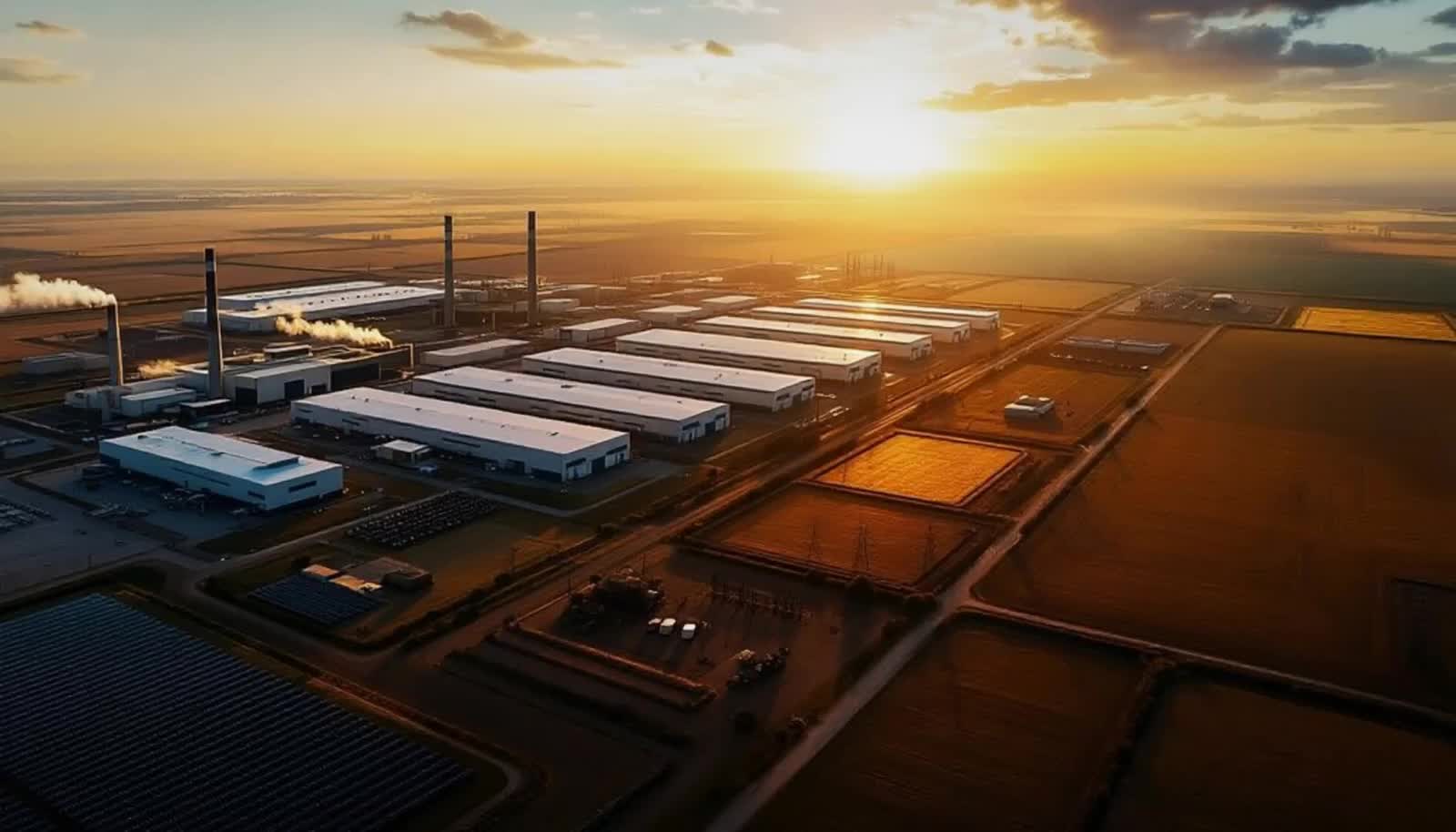
 Concept render
The power behind AI.
Every question you ask an AI runs through warehouses of processors that draw electricity the way a city does. Fermi is building the power to feed them, on its own land, behind its own fence, without raiding the neighborhood's supply.
AI uses more power than any machine ever built.
The real work of AI happens in buildings the size of stadium floors. One rack of AI processors draws the power of 100 homes, and a frontier campus holds thousands of racks.
Why the grid can't feed it.
AI runs on electricity, and the machines arrive faster than America can build power lines. The computers take about a year to build; a grid connection takes three to seven. Against a projected 45 GW shortfall, every campus that plugs into the grid you already use competes for the same electrons, and households see the price first.
One query, then a billion a day.
A single question is trivial. Multiply by billions and demand climbs into gigawatts, the load of a new city.
- One training run · a small cityTeaching a frontier model runs months of nonstop computing at a hundred megawatts or more.
- One Fermi campus · 12M+ homesAt full build the HyperGrid is designed to generate what twelve million homes consume, for machines that never sleep.
Build the power and the data center together.
Fermi is building the power plant and the data center on the same land, behind the same fence, so AI can be fed without pulling from the public grid. Four sources, engineered for the ramp: gas first, then nuclear, solar, and storage.
- Gas · the sprinterCombined-cycle turbines carry day one, with pipelines at the fence.
- Nuclear · the marathonerFour AP1000 reactors filed with the NRC (license under review), planned for low-carbon power, day and night.
- Solar · the day shiftThe Panhandle sun: the cheapest power on campus every midday.
- Storage · the shock absorberGrid-scale batteries answer in milliseconds, smoothing every bump.
Built by hand, and built to stay.
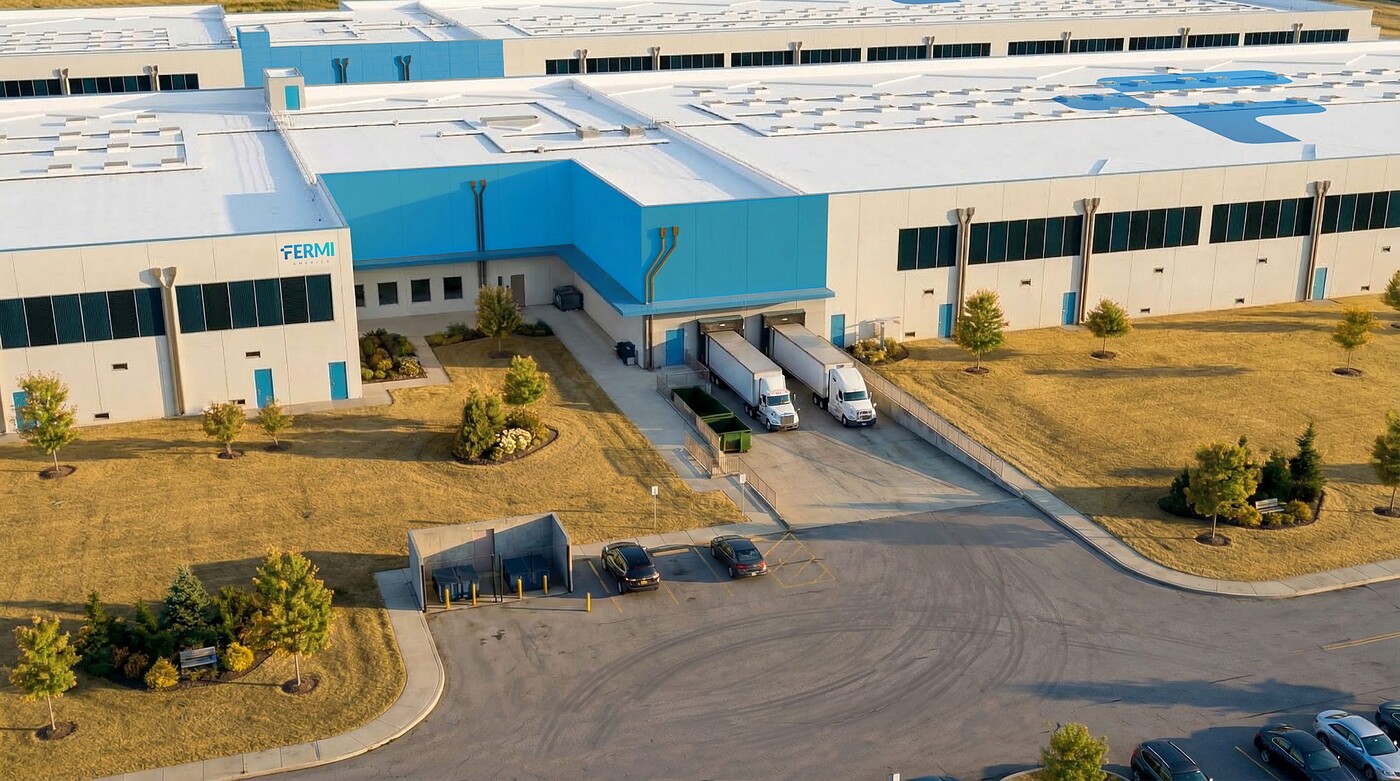
Construction booms fade; the operations payroll and the tax base are the lasting part. At full buildout Fermi expects to create roughly 5,500 permanent jobs, with 600 full-time positions committed under the Carson County agreement.
Good to know.
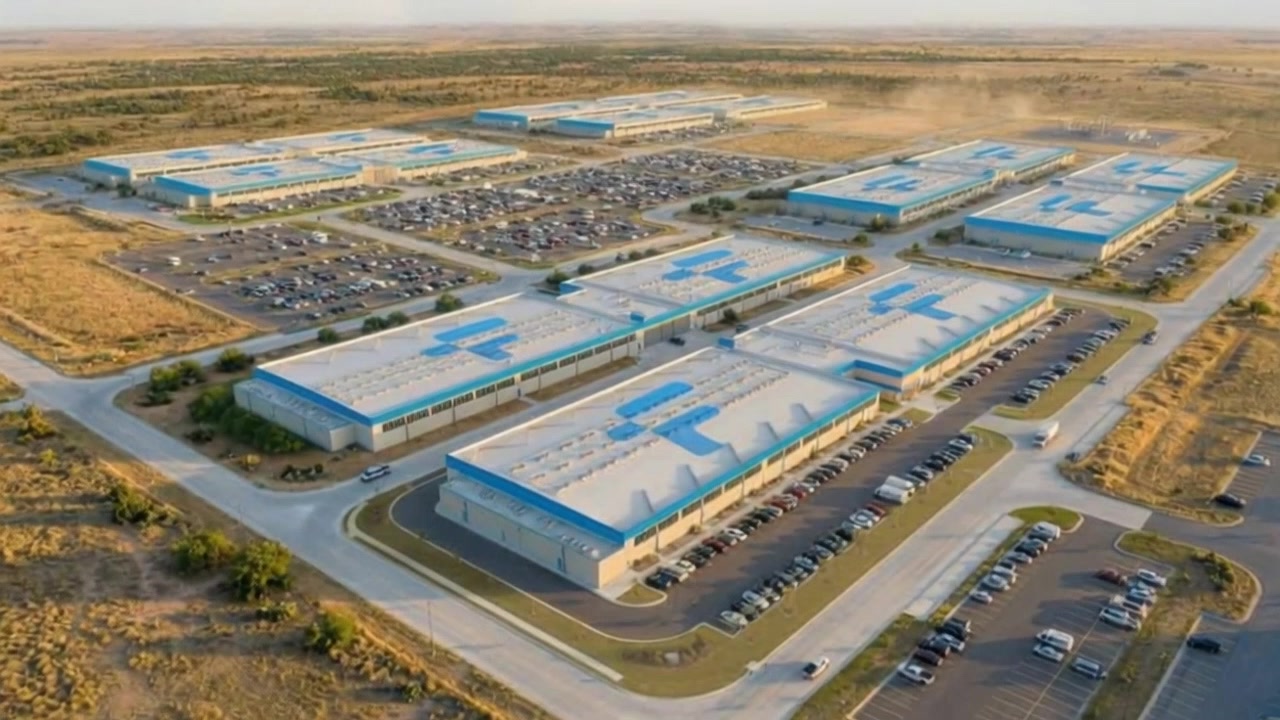
Noise is capped at 75 dB at the fence line under the county agreement, about a vacuum cleaner, fading with distance. As for your bill: the whole point of the private, behind-the-meter design is that the campus makes its own power rather than buying yours, so Fermi’s load is engineered not to bid against Panhandle households for grid electricity.
We take this seriously, and frankly it is in our own interest: we have invested heavily in this region and have no reason to waste a precious resource. Project Matador starts with a firm, contracted 2.5 million gallons a day from the City of Amarillo, roughly the same as a single center-pivot corn field and less than a tenth of one percent of the Panhandle’s annual water use. The power plant is designed for dry, air-cooled or hybrid cooling that uses up to 80% less water than fully water-cooled plants, and the data centers plan to standardize closed-loop cooling that keeps water use below that of an average household. We also plan to recycle and reuse water on-site, draw on reclaimed and non-potable sources unsuitable for homes or farms, and capture rainfall, with the aim of becoming a net water producer.
This is arguably the most safety-scrutinized neighborhood in America. Pantex has handled the nation’s most sensitive nuclear work for decades, so the region already has the security infrastructure, the regulators’ attention, and a nuclear-grade safety workforce. The AP1000 design Fermi filed already operates at Plant Vogtle, and must clear the NRC’s complete licensing and environmental review before a reactor runs.
Project Matador is expected to create nearly 5,500 permanent, high-quality jobs at full buildout, roughly 3,000 of them in data-center operations and the rest across the natural-gas and planned nuclear facilities. During the multi-year build, the project is expected to support more than 10,000 construction jobs a year across the Panhandle, with 600 full-time positions committed under the Carson County agreement. We have engaged established Texas-based contractors, and hiring locally is a priority. See the Fermi newsroom for hiring updates.
It starts with Texas Tech. The campus sits on a 99-year ground lease with the Texas Tech University System, generating long-term royalty income that funds higher education and research across the region for generations. On top of that: property-tax payments under the negotiated agreement ($3 per square foot of improvements, plus $2,500 to $2,750 per megawatt), water purchased at premium rates, thousands of construction paychecks, and a permanent high-wage employer. The agreements are public.
Three ways in.
Want to follow what we're building?
Sign up to hear about milestones, jobs, and community updates from Project Matador.